





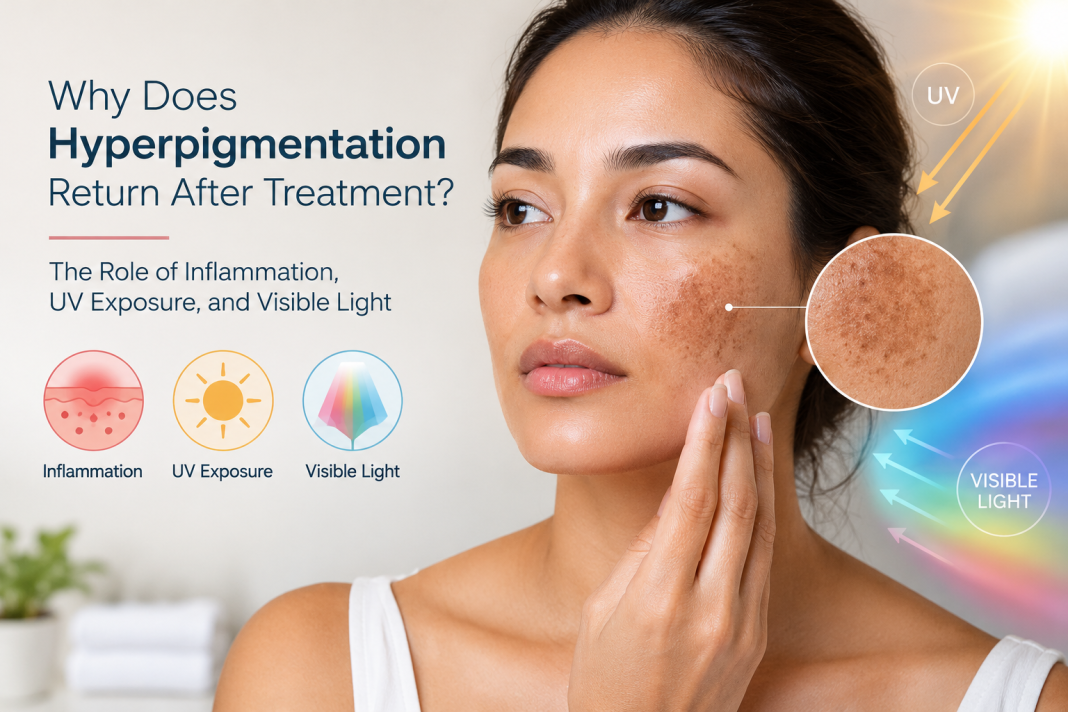
Hyperpigmentation is a common dermatological concern characterised by dark patches or spots caused by increased melanin production or deposition in the skin. Although topical treatments, chemical peels, and laser procedures can improve skin discolouration, pigmentation frequently returns after treatment, particularly in people with melasma or post-inflammatory hyperpigmentation (PIH).
This recurrence can be frustrating for patients who initially achieve visible improvement. However, fading existing pigmentation does not necessarily eliminate the biological processes responsible for its development. Inflammation, ultraviolet (UV) radiation, visible light, and individual susceptibility may continue to stimulate pigment production even after the skin appears clearer (Chaowattanapanit et al., 2017; Sheth & Pandya, 2011).
Understanding these mechanisms is essential for developing effective long-term management strategies rather than relying exclusively on treatments that temporarily lighten the skin.
Why Does Pigmentation Return After Treatment?
The recurrence of hyperpigmentation depends partly on its underlying cause. Melasma is a chronic, relapsing pigmentary disorder influenced by environmental exposure, genetic susceptibility, and multiple biological pathways. By contrast, PIH develops following inflammation or injury, including acne, eczema, burns, and certain cosmetic procedures.
Treatments may reduce existing melanin, accelerate epidermal turnover, or inhibit melanogenesis. Nevertheless, persistent triggers can reactivate pigment production. In addition, aggressive procedures or irritating skincare products may provoke further inflammation and contribute to new pigmentation, especially in darker skin types (Davis & Callender, 2010).
Consequently, treatment success should be assessed not only by the initial reduction in pigmentation but also by the ability to maintain improvement and minimise recurrence.
The Role of Inflammation in Recurrent Hyperpigmentation
Inflammation is an important contributor to PIH. When the skin experiences injury or irritation, inflammatory mediators can stimulate melanocytes, the cells responsible for producing melanin. Increased melanin production and its distribution to surrounding skin cells can leave persistent dark marks even after the original inflammation resolves.
Acne lesions are a common example. Picking pimples, using excessively irritating exfoliants, or undergoing unsuitable cosmetic procedures may prolong inflammation and increase the risk of pigmentation. In some cases, pigment extends into the dermis, where its clearance can be slower and less predictable (Chaowattanapanit et al., 2017).
Preventing recurrent pigmentation therefore requires control of the underlying inflammatory condition. For acne-associated PIH, this includes appropriate acne management and avoiding unnecessary skin trauma. Cosmetic procedures should also be selected according to the patient’s skin type, pigmentary history, and risk of post-procedure inflammation.
How UV Radiation and Visible Light Influence Pigmentation
Ultraviolet radiation is a major environmental trigger for melasma and other pigmentary disorders. UVA and UVB exposure can activate pathways involved in melanogenesis and contribute to oxidative stress and skin inflammation. Repeated exposure may darken existing pigmentation and undermine the results of treatment (Sheth & Pandya, 2011).
Visible light is another important consideration, particularly for individuals with darker skin phototypes. Research indicates that certain wavelengths of visible light can induce persistent pigmentation, and protection against visible light may improve treatment outcomes in melasma.
In a randomized controlled trial, Castanedo-Cazares et al. (2014) compared sunscreens providing UV protection alone with sunscreens offering additional visible-light protection in patients receiving hydroquinone treatment. The group using the UV-visible-light sunscreen achieved greater improvement in melasma severity, supporting the value of broader photoprotection.
This evidence does not mean that every source of visible light causes clinically significant pigmentation. Rather, it highlights the importance of considering solar visible light alongside UV exposure when managing recurrent pigmentary disorders.
Evidence-Based Strategies to Reduce Recurrence
Long-term management should address both existing pigmentation and the factors that reactivate melanin production.
Consistent photoprotection: Broad-spectrum sunscreen with SPF 30 or higher is a foundation of care. For patients with melasma or recurrent pigmentation, a tinted sunscreen containing iron oxides may provide additional protection against visible light. Appropriate application, reapplication, shade, and protective clothing also matter (Davis & Callender, 2010).
Control inflammation: Treating acne, eczema, and other inflammatory conditions can help prevent new PIH. Avoid picking lesions and introducing multiple irritating skincare products simultaneously.
Individualised topical treatment: Ingredients such as azelaic acid, retinoids, and hydroquinone may be appropriate in selected cases. Choice and duration depend on the diagnosis, skin sensitivity, and clinical guidance. Some agents can themselves cause irritation if used incorrectly.
Careful procedural selection: Chemical peels and laser treatments may benefit selected patients, but procedures can also trigger PIH. Melasma has a particularly high recurrence risk, and some laser approaches may cause additional pigmentary complications. A qualified clinician should assess suitability and discuss realistic outcomes before treatment (Trivedi et al., 2017).
Recurrent hyperpigmentation is not simply a failure of skin-lightening treatment. It often reflects the persistence of biological and environmental triggers that continue to stimulate pigment production after visible improvement.
Inflammation, UV exposure, and visible light can all contribute to recurrence, although their relative importance varies by diagnosis and individual susceptibility. Effective management therefore combines appropriate treatment with inflammation control, consistent photoprotection, and long-term maintenance.
For dermatology and aesthetic practitioners, the central goal should be sustained pigment control rather than temporary lightening alone.
References
- Castanedo-Cazares, J. P., Hernández-Blanco, D., Carlos-Ortega, B., Fuentes-Ahumada, C., & Torres-Álvarez, B. (2014). Near-visible light and UV photoprotection in the treatment of melasma: A double-blind randomized trial. Photodermatology, Photoimmunology & Photomedicine, 30(1), 35–42. https://doi.org/10.1111/phpp.12086
- Chaowattanapanit, S., Silpa-Archa, N., Kohli, I., Lim, H. W., & Hamzavi, I. (2017). Postinflammatory hyperpigmentation: A comprehensive overview: Treatment options and prevention. Journal of the American Academy of Dermatology, 77(4), 607–621. https://doi.org/10.1016/j.jaad.2017.01.036
- Davis, E. C., & Callender, V. D. (2010). Postinflammatory hyperpigmentation: A review of the epidemiology, clinical features, and treatment options in skin of color. The Journal of Clinical and Aesthetic Dermatology, 3(7), 20–31. https://pmc.ncbi.nlm.nih.gov/articles/PMC2921758/
- Sheth, V. M., & Pandya, A. G. (2011). Melasma: A comprehensive update: Part II. Journal of the American Academy of Dermatology, 65(4), 699–714. https://doi.org/10.1016/j.jaad.2010.12.044
- Trivedi, M. K., Yang, F. C., & Cho, B. K. (2017). A review of laser and light therapy in melasma. International Journal of Women’s Dermatology, 3(1), 11–20. https://doi.org/10.1016/j.ijwd.2017.01.004


